
The Mechanics of Motion: How Do Cabinet Door Hinges Work
- By:
- Date:2026/09/25
When you open a kitchen cupboard to grab a coffee mug, you rarely consider the complex mechanical ballet happening out of sight. A slight pull initiates a highly controlled pivot, governed by mechanical tension and precise geometric alignment.
Homeowners and architectural designers inevitably ask how do cabinet door hinges work when a wooden panel begins to sag or fails to close smoothly. Understanding the underlying physical science allows you to diagnose structural failures immediately.
Grasping these kinetic principles empowers you to maintain your heavy architectural hardware effectively. It also provides the foundational knowledge required to select the precise mechanical component for custom furniture fabrication and complex interior millwork installations.
The Invisible Forces Holding Your Cabinetry Together
Modern interior architecture relies entirely on the reliability of concealed mechanical articulation. These hidden linkages must support substantial physical weight while remaining completely invisible from the exterior aesthetic facade.
The transition from static structural mounting to dynamic kinetic movement requires immense engineering precision. Poorly calibrated mechanical joints create immediate physical friction, leading to premature material fatigue and eventual total system failure.
Architects must calculate exact physical clearances before specifying the internal hardware for a specific room. This mathematical foresight ensures the physical door arcs do not intersect with adjacent domestic appliances, interior walls, or overhead lighting fixtures.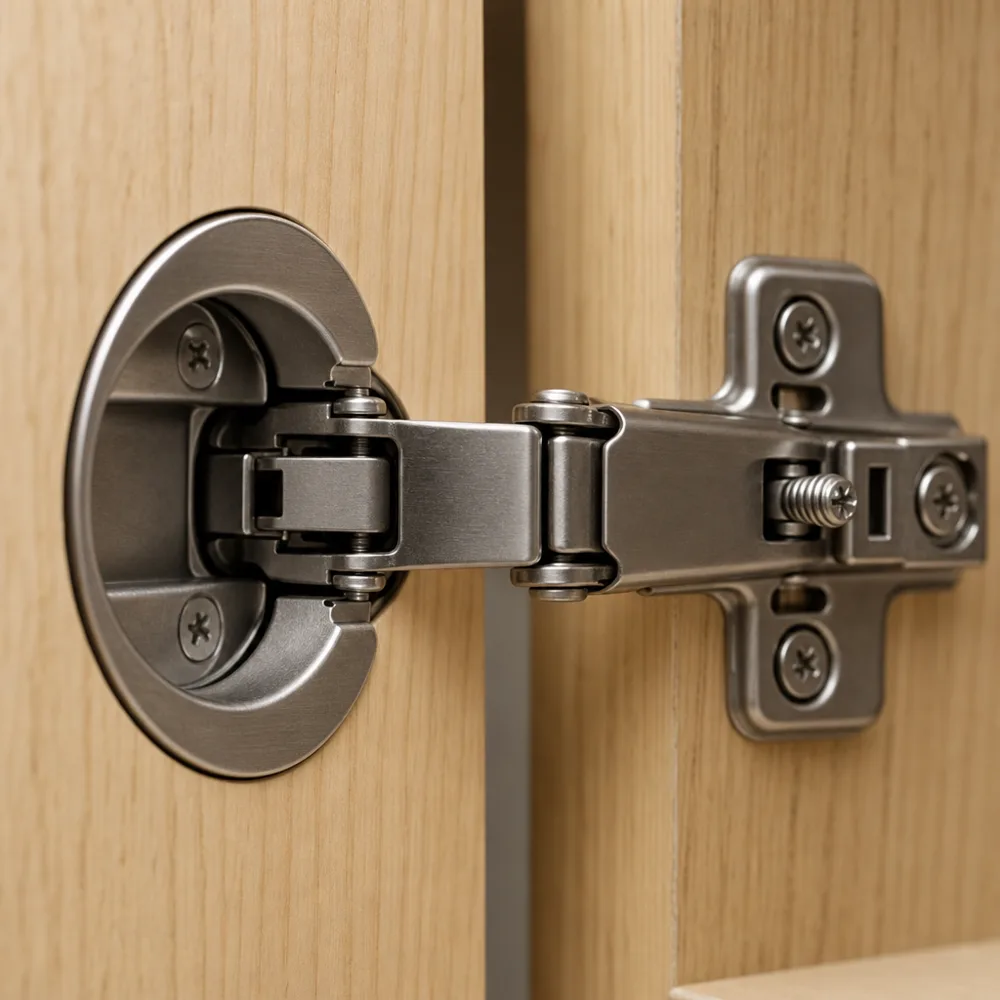
A Brief Industrial History of Cabinet Articulation
Early furniture artisans utilized rudimentary iron butt hinges mortised directly into the solid timber. This primitive approach demanded exact carpentry skills and offered absolutely zero post-installation adjustability for the end user.
If the raw wood expanded due to natural seasonal humidity changes, the cabinet doors would inevitably bind harshly against the wooden frame. This structural limitation frustrated carpenters and homeowners alike for several centuries.
The true industrial revolution in cabinet kinematics occurred with the development of the concealed European hardware format. Post-war mass manufacturing demanded rapid factory assembly techniques to keep pace with global housing booms.
Industrial engineers required a versatile mechanical solution that separated the physical door preparation from the internal cabinet box installation. This philosophical shift in manufacturing birthed the highly standardized thirty-five-millimeter circular hardware format.
Core Anatomy: Breaking Down the Hinge Structure
To thoroughly answer how do cabinet door hinges work within a modern environment, we must systematically dissect the hardware into its constituent metal components. Every single concealed linkage fundamentally relies on a specific triad of parts.
The primary component is the circular hinge cup that rests securely inside the bored cavity on the back of the door. This specific metallic bucket acts as the foundational structural anchor point for the entire mechanical assembly.
This cup bears the vast majority of the rotational sheer force during daily operation. It firmly houses the primary metallic pivot pins and often contains the initial stages of complex internal dampening mechanisms.
Connecting the internal cup to the cabinet frame is the multi-jointed steel hinge arm. This highly engineered metallic bridge directly translates simple linear pulling movement into complex mathematical rotational arcs.
The mounting plate physically secures this entire bridge firmly to the interior cabinet casing. This vital base component provides the intensely stable physical foundation required for heavy leverage and structural load distribution.
The Physics Behind the Rotational Arc
Unlike a standard interior household door that swings simply on a single fixed vertical pin, concealed cabinetry hardware utilizes a complex four-bar mechanical linkage system. This geometry forces the door slightly outward as it opens.
This specific outward trajectory successfully prevents the thick wooden edge of the cabinet door from binding tightly against the internal structural frame. It is a brilliant mathematical solution to a deeply annoying spatial problem.
When you pull the metal handle, the internal hinge arm pivots dynamically across multiple steel rivets. Small spring steel components inside the base mechanism actively store kinetic energy as the door approaches its maximum opening threshold.
This internal structural tension prevents the heavy wooden door from swinging wildly out of control. As you push the panel closed, that stored spring tension eventually takes over the physical workload completely.
At a specific geometric mathematical threshold, usually around thirty degrees, an internal metal spring snaps into a new alignment. This aggressive mechanical shift forcefully pulls the heavy wooden door shut against the flat cabinet face.
Fluid Dynamics in Soft Closing Technology
The violent snap of a traditional self-closing mechanism often leads to jarring acoustic noises and gradual structural degradation. The hardware industry addressed this harsh physical impact through the brilliant integration of miniature hydraulic fluid dynamics.
Modern soft close hardware utilizes microscopic fluid dynamics to actively counteract the aggressive pull of the internal tension spring. Inside the metal housing sits a tiny brass or plastic hydraulic dampening cylinder.
This small structural cylinder contains a highly precise volume of industrial high-viscosity silicone oil. A metallic plunger moves linearly through this thick fluid as the cabinet door naturally swings toward its closed resting position.
The plunger features microscopic internal channels that only allow the silicone oil to pass through at a strictly regulated flow rate. This intense fluid resistance actively converts the kinetic energy of the moving door into minute amounts of thermal energy.
Two-Way Articulation Versus Standard Functionality
Standard hydraulic hardware operates exclusively on a repetitive one-way tension cycle, constantly applying aggressive pulling force to the internal mounting base. Over years of heavy domestic utilization, this relentless action degrades the furniture.
This constant pulling action can slowly extract the primary mounting screws directly from the soft wooden cabinet walls. This specific hardware extraction inevitably causes severe physical door shift and critical aesthetic alignment failures over time.
For us, pioneering the two-way soft closing hinge required integrating standard dampening features with complex two-way geometric operational arcs. This internal mechanical innovation successfully neutralized the specific safety hazards associated with long-term base plate loosening.
By completely neutralizing the mechanical spring tension when the door sits fully open, the hardware drastically reduces the static physical load placed on the composite cabinet materials. This architectural geometry significantly extends the hardware’s overall operational lifespan.
This specific two-way mechanical neutral zone acts as a critical structural safety feature in heavy architectural millwork. Large storage pantry doors or heavy glass display panels naturally exert massive physical torque on their foundational pivot points.
Decoding Hinge Overlays and Geometry
Selecting the absolute correct mechanical hardware requires a deep technical understanding of modern cabinet construction typologies. The specific spatial relationship between the wooden door and the internal cabinet box dictates the exact physical geometry required.
Using the mathematically incorrect hardware configuration results in overlapping doors that cannot physically open without severely damaging adjacent panels. The full overlay configuration remains the most heavily utilized geometric setup in modern frameless kitchen cabinetry.
In a full overlay setup, the front door completely covers the leading vertical edge of the internal cabinet box. This specific design leaves only a tiny aesthetic shadow gap between multiple adjacent wooden doors.
Half overlay mechanical configurations are utilized heavily when two separate doors must share a single central cabinet structural partition. The internal metal hinge arm features a distinct structural crank to avoid immediate physical collision.
Inset structural configurations actively push the heavy wooden door completely inside the raw cabinet frame. The internal hardware arm requires a massive, pronounced structural crank to reach cleanly around the thick cabinet casing.
Technical Specifications and Configuration Matrix
To rapidly clarify these complex architectural alignments, we must carefully consider the exact dimensional constraints of each unique hardware type. Proper structural installation requires strict adherence to documented boring margins and internal cup depths.
| Configuration Type | Hardware Arm Shape | Door Position Relative to Frame | Typical Boring Margin | Applicable Scenarios |
|---|---|---|---|---|
| Full Overlay | Completely Straight | Fully covers the cabinet side panel | 3mm – 6mm | Frameless kitchens, modern wardrobes |
| Half Overlay | Half Cranked Bend | Covers exactly half of the side panel | 3mm – 6mm | Shared partitions in long vanity banks |
| Inset Design | Full Cranked Bend | Sits perfectly flush entirely inside the frame | 4mm – 7mm | Traditional furniture, architectural flush-mount designs |
| Blind Corner | Special Complex Geometry | Mounts directly to an adjacent false panel | 4mm – 5mm | L-shaped kitchen corners, tight spatial constraints |
| Pie Cut System | Bi-fold Linked Joints | Connects two separate wooden doors together directly | 3mm – 5mm | Rotating corner carousels, bi-fold pantry systems |
This technical matrix dictates the foundational mathematics of internal cabinet design. Every single structural specification must be verified against the physical dimensions of the manufactured wooden panels to guarantee completely flawless operational movement.
Specialized Hardware for Niche Applications
While standard thick wood panels completely dominate heavy residential construction, commercial interior environments demand highly specialized kinematic solutions. Heavy glass architectural doors, for instance, cannot accept a standard thirty-five-millimeter bored circular timber cavity.
These fragile transparent surfaces require highly specialized structural hinges that physically clamp onto the raw glass via threaded metallic bezels. Aluminum frame doors present an entirely different, yet equally complex, internal mechanical challenge.
The exceptionally thin metal architectural extrusion lacks the physical structural depth required for a standard deep hardware cup. Manufacturers produce specialized shallow-cup hardware designed explicitly to slide securely into the narrow internal channels of the aluminum extrusion.
Extremely thick architectural wooden doors, exceeding twenty-two millimeters, will immediately bind against standard hinges due to sheer physical mass. Thick-door hinges feature a radically specialized pivot geometry that pushes the door much further away during opening.
The Mechanics of Tri-Axial Adjustment
The absolute brilliance of concealed cabinetry hardware lies heavily in its extreme post-installation mechanical adaptability. A perfectly plumb wooden cabinet box rarely exists in the challenging reality of fast-paced residential interior construction.
Structural internal walls bow over time, heavy timber floors slope slightly, and raw wooden doors naturally warp under shifting environmental humidity. Depth adjustment specifically controls the vital visual gap between the back of the door and the cabinet.
Turning the rear mechanical cam screw on the internal hinge arm physically pushes the entire door structure forward or pulls it tightly backward. This specific adjustment ensures a perfectly even visual reveal along the entire vertical plane.
Lateral side adjustment directly dictates the exact horizontal position of the wooden door. Turning the central adjustment screw physically alters the resting angle of the metal hinge arm, allowing installers to perfectly align vertical structural gaps.
Height adjustment relies entirely on the precise physical positioning of the heavy mounting plate secured to the internal cabinet wall. This vertical adjustment perfectly levels the top horizontal edges of the wooden doors across wide aesthetic expanses.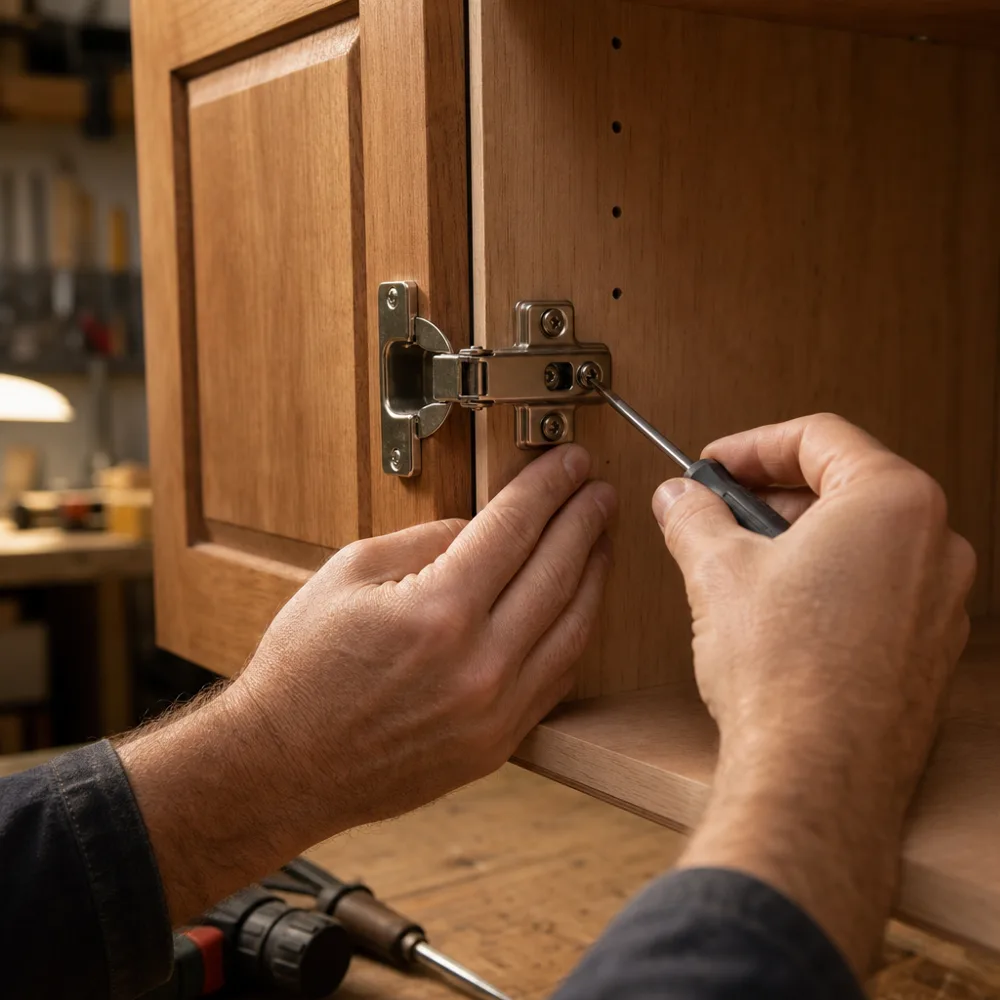
Diagnosing Mechanical Degradation
Internal hardware failure rarely occurs instantly within a residential environment; it usually follows a highly predictable chronological path of mechanical degradation. When users notice a wooden door scraping against a timber frame, something is mathematically wrong.
This abrasive physical contact indicates a severe shifting of the internal metallic pivot points or a dangerous loosening of the primary structural anchorage system. Screws stripping completely out of the composite cabinet materials remains the most frequent issue.
Repeated kinetic mechanical shock from aggressively slamming doors eventually pulverizes the microscopic wood fibers surrounding the threaded metal fasteners. Once these specific structural fibers fail, the internal mounting plate completely loses its necessary structural integrity.
Catastrophic internal spring failure manifests physically as heavy wooden doors that simply refuse to remain securely closed. The high-tension structural steel springs completely lose their vital physical memory after tens of thousands of operational cycles.
Hydraulic fluid leakage destroys delicate soft-closing fluid mechanisms completely silently. If the microscopic internal seals fail under pressure, the silicone oil escapes, and the door immediately reverts to a highly destructive, harsh slamming trajectory.
Preventative Maintenance Protocols
Ignoring the mechanical health of your internal architectural hardware essentially guarantees premature structural failure. A microscopic amount of routine preventative physical care significantly extends the operational lifespan of concealed metallic linkages by multiple decades.
The specific environmental atmosphere directly dictates the absolutely necessary frequency of these mechanical maintenance interventions. Commercial kitchen environments constantly expose metal structural linkages to airborne moisture, atomized cooking oils, and highly acidic chemical cleaning vapors.
This microscopic airborne debris slowly settles deeply into the internal metallic cam tracks, acting directly as a highly abrasive grinding paste. Homeowners should always perform a completely dry wipe of all internal cabinet hardware bi-annually.
Routine hardware maintenance requires three distinct parallel actions:
- Inspecting the structural integrity of the base plate mounting screws.
- Lubricating the primary internal pivot rivets with specialized dry-film lithium.
- Re-calibrating the tri-axial internal cam screws to restore precise door alignment.
Frequently Asked Questions About Hinge Operation
Why does my heavy cabinet door spring open slightly instead of staying tightly closed?
This specific physical phenomenon occurs rapidly when the internal tension spring geometry falls completely out of mathematical alignment. If the structural hinge is adjusted too far forward on the depth axis, the metal cam profile cannot reach its final resting position. Re-adjusting the rear depth screw usually solves this specific internal tension issue.
Can I safely mix soft-closing and standard mechanical hinges on the exact same door?
While physically possible to install, blending these distinct mechanical systems creates highly uneven kinetic stress. The soft-closing hardware will forcefully attempt to slow the moving door, while the standard steel spring pulls highly aggressively. This mechanical disparity exerts massive twisting forces on the wooden door panel, eventually warping the solid timber permanently.
What actually causes the highly annoying squeaking noise in fully concealed hinges?
Acoustic squeaking originates entirely from intense metal-on-metal friction deep within the internal structural rivet joints. As protective factory lubrication slowly evaporates or heavily attracts airborne kitchen grease, the vital metallic pivot pins dry out. Applying a specialized dry-film lithium chemical lubricant to the internal mechanical joints successfully restores perfectly silent operation.
Transitioning from Static to Kinetic Manufacturing
Understanding the complex physical origins of these metallic mechanisms requires examining the highly precise modern manufacturing environment. The sheer kinetic physical forces experienced by cabinet hardware necessitate absolutely flawless industrial metallurgical fabrication.
The modern manufacturing process begins immediately with the precise industrial stamping of thick raw steel coils. Heavy hydraulic presses utilize immense physical tonnage to punch the intricate base shapes of the hinge cups and mounting plates.
These raw stamped metallic components then move rapidly through highly automated progressive formation lines. Here, precisely calibrated mechanical dies fold the flat steel panels into the complex three-dimensional geometric shapes required for internal kinetic leverage.
For components demanding extreme structural density, advanced industrial pressure casting techniques replace traditional flat steel stamping. Hot liquid zinc alloys are forcefully injected directly into hardened steel molds, creating perfectly solid hinge arms capable of resisting massive architectural torque.
Future Trajectories in Furniture Hardware
The seamless integration of advanced electronic automated actuation currently represents the absolute next frontier in modern cabinet kinematics. Innovative touch-to-open servo systems completely eliminate the architectural need for bulky exterior handles entirely.
A remarkably gentle physical push directly against the exterior door face triggers a hidden electronic mechanical motor. This silent motor physically pushes the heavy wooden panel outward completely automatically, redefining the modern architectural kitchen experience.
Chemical material science also continues to evolve rapidly, successfully replacing heavy stamped steel internal components with highly advanced carbon-fiber-reinforced industrial polymers. These lightweight composite materials offer vastly superior overall tensile strength while completely eliminating the persistent environmental risk of rust.
As architectural design pushes aggressively toward heavily oversized monolithic door panels, hinge engineering must compensate for unprecedented vertical weight loads. The traditional four-bar linkage is evolving into highly complex multi-bar systems, distributing massive kinetic physical forces across a much wider surface area.
Ultimately, thoroughly understanding the highly complex machinery hidden entirely within your interior cabinetry fundamentally changes how you interact with your physical living space. Knowing precisely how do cabinet door hinges work empowers you to maintain internal structural alignment effectively.
This highly specific mechanical knowledge prevents catastrophic architectural hardware failure across your entire home. The beautifully silent, perfectly fluid operational motion of a mathematically calibrated cabinet door remains the absolute truest indicator of high-quality interior woodworking craftsmanship.
CONTACT US


GuangDong JinLi XiangXing Precision Metal Manufacturing Co., Ltd.
We are always providing our customers with reliable products and considerate services.
If you would like to keep touch with us directly, please go to contact us
-

Home
-

Tel
-

Email
-

Contact