
The Engineering Behind Cabinet Door Systems: How to Replace Cabinet Door Hinges Without Compromising
- By:
- Date:2026/09/24
A sagging cabinet door is rarely a symptom of failing wood. The structural integrity of your cabinetry relies entirely on the hidden mechanical joints bridging the frame and the panel. Understanding the physics of these joints is mandatory before learning how to replace cabinet door hinges.
Heavy solid wood panels exert continuous leverage against their pivot points. Gravity acts constantly on the outer edge of the door. This force multiplies at the mounting plate. Standard hardware yields to this constant torque over months of regular use.
Users frequently attempt to fix alignment issues by tightening stripped screws. This approach ignores the fundamental mechanical failure occurring inside the articulation arm. A proper replacement strategy requires assessing the load-bearing capacity and the internal damping mechanics of the new hardware.
Diagnosing Hardware Fatigue in Residential Cabinetry
Metal fatigue in residential cabinetry hardware manifests through microscopic fractures along the hinge cup. The articulating arm bears the dynamic load during every opening cycle. The constant tension weakens the structural matrix of low-grade steel over time.
You will notice this degradation when doors begin to rub against adjacent panels. The gap between dual doors becomes uneven and erratic. Adjusting the mounting plate no longer holds the door square. The pivot pins have likely worn down their internal housing.
Identifying this mechanical wear early prevents catastrophic damage to the cabinet box. Ripped screw holes require complex carpentry to repair properly. Replacing the joint before the mounting plate tears out saves the structural integrity of the surrounding wood.
For us, extensive testing reveals that a reliable joint must withstand immense cyclical stress. Engineering a mechanism to survive 80,000 closing cycles requires specific metallurgical choices. It is a matter of distributing kinetic energy across a wider surface area.
The Geometry of Door Overlays
Understanding the spatial relationship between the door and the cabinet frame is critical. Manufacturers categorize this relationship into three distinct geometrical configurations. You must identify your current configuration before purchasing replacement hardware to ensure spatial compatibility.
Full overlay systems conceal the entire front edge of the cabinet box. The door sits completely proud of the frame when closed. This design creates a seamless aesthetic with minimal visible gaps between adjacent doors.
The hinge arm for a full overlay application features a completely straight profile. This straight geometry allows the door to pivot outward without striking the cabinet side. The pivot point rests exactly parallel to the mounting plate.
Half overlay configurations are common in modular cabinetry featuring shared center partitions. Two doors share a single vertical divider block. Each door covers exactly half the thickness of the wooden partition. This requires a specific crank in the hinge arm.
The half overlay arm bends inward slightly toward the center. This bend shifts the door’s resting position toward the middle of the opening. It prevents the two adjacent doors from colliding during simultaneous operation.
Inset doors sit entirely flush inside the cabinet frame. The front face of the door aligns perfectly with the front edge of the cabinet box. This traditional style requires the most precise alignment and extreme hinge geometry.
An inset hinge utilizes a highly pronounced crank in its articulation arm. This deep bend allows the door to swing entirely out of the frame cavity. The spatial adjustment capabilities are absolutely vital here to maintain uniform gaps.
The Mechanics of Spatial Adjustment Systems
Basic hinges offer static mounting positions with zero room for error. Wood naturally expands and contracts with ambient humidity. A fixed joint cannot accommodate these seasonal dimensional shifts. This rigid approach causes doors to bind during summer months.
Modern hardware solves this physical constraint through eccentric cam systems. These integrated screws alter the geometry of the hinge arm without loosening the base plate. Turning the adjustment screw shifts the internal cam, altering the door position microscopically.
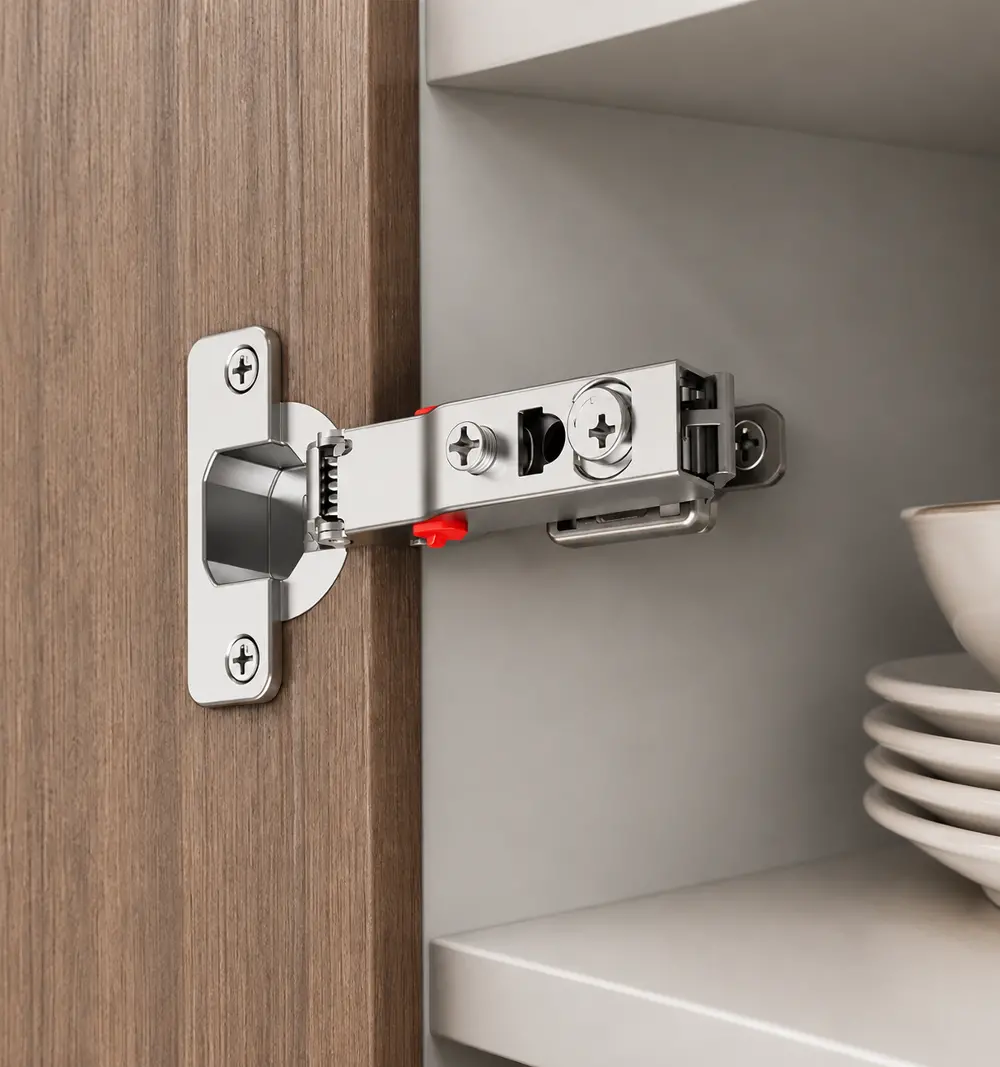
A true three-dimensional adjustment system provides six directions of spatial control. You can manipulate the depth, side clearance, and vertical height independently. This precise calibration ensures uniform gaps across an entire wall of complex cabinetry.
Side adjustment corrects the parallel alignment between twin exterior doors. Depth adjustment seals the door perfectly against the cabinet bumper. Height adjustment levels the top edges across the entire horizontal plane, compensating for minor mounting inaccuracies.
Material Science in Hardware Manufacturing
Kitchen environments subject metal hardware to severe atmospheric abuse constantly. Boiling water releases dense steam clouds that settle inside closed cabinets. Cooking oils vaporize and condense on cold metal surfaces, creating a highly corrosive microclimate.
Raw steel oxidizes rapidly under these hostile atmospheric conditions. Manufacturers often apply a thin zinc wash to reduce production costs. This superficial barrier degrades quickly under friction. Once the protective layer scratches, galvanic corrosion destroys the underlying steel.
We approach this environmental challenge through multi-layered electroplating techniques. A dense copper plating adheres directly to the carbon steel core. This copper layer acts as an impermeable bonding agent. A subsequent layer of nickel provides the final exterior armor.
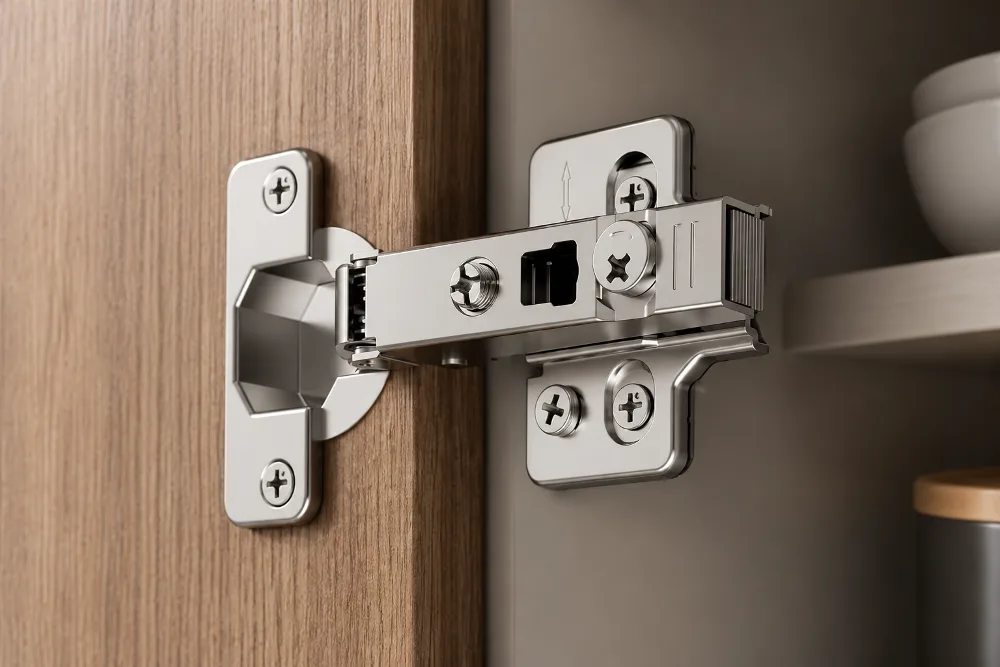
The resulting surface architecture survives aggressive 48-hour salt spray testing protocols. The copper-nickel matrix resists microscopic pitting from acidic household cleaning agents. The mechanism maintains its structural tolerance and smooth operation even in dense coastal humidity.
Buffer On-Off Technology and Hydraulic Dynamics
Slamming a heavy wooden door sends a violent shockwave through the cabinet frame. This kinetic energy transfers directly into the mounting screws. Repeated impacts eventually strip the delicate threads anchoring the plate to the particle board.
Early soft-close mechanisms used simple pneumatic resistance to slow the heavy door. Air compresses unpredictably based on ambient room temperature. These primitive designs often failed to pull the door completely shut, leaving a frustrating gap requiring physical intervention.
Advanced damping technology utilizes sealed hydraulic cylinders filled with viscous fluid. As the door closes, a piston forces the oil through a microscopic valve. The fluid’s viscosity absorbs the kinetic energy, converting momentum into harmless thermal energy.
Progressive two-way soft closing systems eliminate the dangerous spring-back effect entirely. They integrate the buffering cylinder directly into the articulating steel arm. This design prevents the door from bouncing off the frame violently.
Our buffer on-off technology grants users complete control over this hydraulic resistance. You can adjust the closing speed to match the door’s total mass. A heavy pantry door requires maximum fluid resistance, while a vanity door needs minimal damping.
Step-by-Step Engineering Protocol: How to Replace Cabinet Door Hinges
Mastering how to replace cabinet door hinges requires a systematic approach to alignment. You must respect the geometry of the existing cabinet box. Removing old hardware is straightforward, but positioning new mounting plates demands absolute precision.
Start by supporting the weight of the heavy door from below. Remove the screws connecting the hinge arm to the mounting plate. Never remove the cup screws first, as the sudden drop will damage the adjacent cabinet face.
Inspect the existing circular mortise inside the wooden door cavity. Most modern residential cabinetry uses a standard 35mm bore diameter. Clean out any accumulated sawdust or grease. A clean cavity ensures the new cup sits perfectly flush.
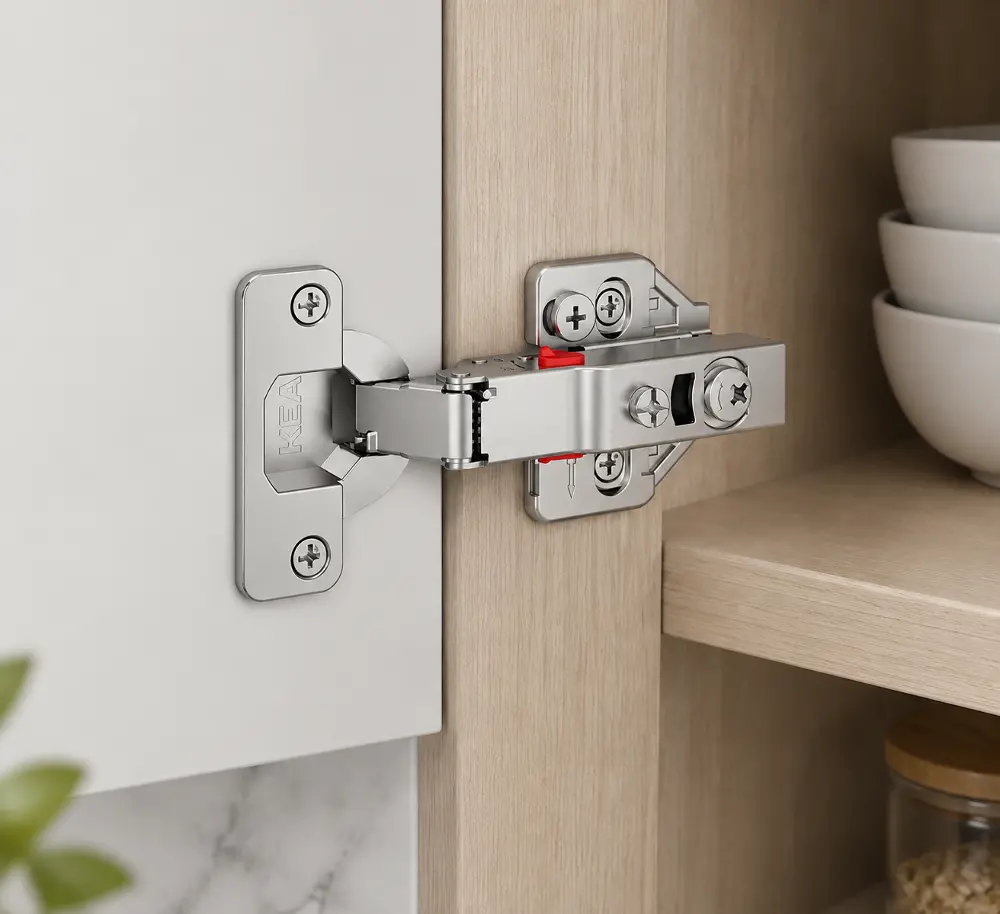
Installing the new hardware begins with the one-shaped plane base. This any-click system drastically reduces the physical effort required for vertical mounting. You attach the base plate to the cabinet wall independently. The door assembly then snaps directly onto it.
Align the hinge arm precisely over the secure mounting bracket. Apply firm pressure until the internal latch engages with an audible click. This tool-less connection secures the heavy door instantly, eliminating the need to balance wood while driving screws.
Perform your initial spatial adjustments immediately after hanging the door. Turn the depth cam until the door rests gently against the rubber bumpers. Adjust the lateral cam to equalize the vertical gap between the door and the frame.
Application Scenarios and Load Distribution
Different architectural applications demand specific hardware configurations for optimal performance. A modern kitchen requires hinges capable of handling high-frequency daily operation. A custom wardrobe system prioritizes aesthetic integration and completely silent movement.
Solid wood doors carry immense density per square inch of surface area. An oak pantry door can easily exceed twenty pounds of hanging weight. Supporting this mass requires specialized hardware equipped with extended metal base plates.
The elongated footprint distributes the heavy torque across a larger section of grain. Aluminum frame glass doors present a uniquely difficult structural challenge. The narrow metal profile offers minimal surface area for driving mounting screws securely.
Specialized joints grip the thin extrusion without compromising the fragile glass panel. For large-scale commercial interior projects, maintenance efficiency dictates the hardware selection process. Facility managers cannot afford to recalibrate hundreds of sagging doors monthly.
Commercial environments rely on joints engineered with high-carbon steel and permanent hydraulic seals. Every specific room dictates the physical requirements of the mechanical joint. You must match the hardware’s verified cycle rating to the anticipated foot traffic.
Hardware Specification Baseline
Evaluating mechanical joints requires looking past the exterior finish to the engineering metrics. The following data table illustrates the structural differences between basic joints and professional hardware.
| Engineering Metric | Standard Alloy Hardware | Professional Grade Hardware |
|---|---|---|
| Core Material Base | Zinc-washed standard steel | Copper-plated nickel-plated steel |
| Cycle Endurance Rating | 15,000 to 20,000 cycles | Tested to 80,000+ closing cycles |
| Spatial Adjustment | Vertical shifting only | 3D adjustment across 6 directions |
| Corrosion Resistance | Unrated in high humidity | 48-hour salt spray rust resistance |
| Damping Mechanism | Unsealed pneumatic springs | Adjustable sealed hydraulic cylinders |
| Installation Method | Manual screw driving required | Any-click one-shaped plane base |
Acoustic Engineering and Environmental Standards
The acoustic profile of a residential space changes dramatically with proper mechanical hardware. A busy kitchen generates significant impact noise from closing heavy wood panels. High-frequency slamming triggers stress responses and disrupts the acoustic harmony of the home.
Hydraulic damping technology acts as a highly effective acoustic isolator. The viscous fluid neutralizes the kinetic energy before it strikes the cabinet frame. This mechanical intervention drops the decibel level of a closing door down to a whisper.
Material safety dictates modern manufacturing requirements just as much as structural strength. Adhering strictly to Euro E1 quality and health standards ensures maximum interior safety. No volatile organic compounds escape the factory during the complex manufacturing sequence.
The electroplating baths and chemical treatments prioritize ecological safety alongside structural durability. For us, operating a massive factory space means controlling every minute variable. The journey from the initial raw material cut to final assembly happens internally.
This closed-loop manufacturing system prevents substandard alloys from entering the main production line. The pressure casting stages rely on advanced automatic production lines. Human error is eliminated from the micro-calibration of the sensitive hydraulic cylinders.
Every single mechanical joint receives identical pressure testing before it enters the packaging phase. This rigorous methodology guarantees that the damping cylinders perform consistently under heavy loads. Consistent quality control translates directly into reliable functionality for the end user.
Technical Troubleshooting Frequently Asked Questions
Why do my newly installed doors still snap shut aggressively against the frame?
The hydraulic cylinder likely requires manual calibration to match the door weight. Heavy wood panels need more fluid resistance to overcome their own momentum. Locate the buffer on-off switch on the hinge arm. Adjust the setting to increase the damping pressure until the close is completely smooth.
Do taller cabinet doors require heavier hinges or just a larger quantity?
Vertical height amplifies the mechanical leverage acting on the top pivot joint. Adding a third or fourth hinge distributes this sheer force safely. You do not need a mechanically different hinge model. You simply need to increase the total number of anchor points along the vertical axis.
Can I mix old rigid hardware with new soft-closing models on the same door?
Mixing different mechanical systems creates fundamentally conflicting pivot radiuses. The hydraulic damper will fight against the uncontrolled spring of the older hardware. This uneven tension will warp the wooden door permanently over time. Always replace every joint on a single door simultaneously.
Why is the 35mm cup not sitting flush inside the old wooden mortise?
Legacy cabinetry sometimes utilized 26mm or noticeably shallower boring depths. Modern hydraulic systems require a specific cavity volume to house the damping mechanism. You may need to use a precision Forstner bit to deepen the existing hole slightly.
Securing Long-Term Structural Integrity
Every component in a modern cabinetry system operates as part of a kinetic chain. A failure at the pivot point compromises the entire structural assembly. The hardware you choose directly dictates the lifespan of the wooden framework it supports.
38 years of intense manufacturing experience taught us that precision engineering cannot be faked. High-quality raw materials form the absolute baseline of any reliable mechanical mechanism. True value lies in the microscopic tolerances achieved during the complex stamping process.
We spent 38 years engineering the perfect geometry for the articulating steel arm. Holding numerous patents represents a continuous battle against daily mechanical wear. A superior joint absorbs the physical abuse of a busy household without transferring stress.
Choosing hardware complying with strict environmental standards ensures safety alongside mechanical superiority. The manufacturing process matters just as much as the final functional product. Sustainable engineering creates mechanisms that outlast the fleeting aesthetic trends of the modern kitchen.
Knowing how to replace cabinet door hinges gives you absolute control over your environment. You can permanently eliminate the jarring noise of slamming wooden panels. The right hardware transforms a static wooden box into a refined and interactive architectural system.
CONTACT US


GuangDong JinLi XiangXing Precision Metal Manufacturing Co., Ltd.
We are always providing our customers with reliable products and considerate services.
If you would like to keep touch with us directly, please go to contact us
-

Home
-

Tel
-

Email
-

Contact