
Mechanics of Cabinet Alignment: How to Fix Cabinet Door Hinges and Identify Hardware Failures
- By:
- Date:2026/09/23
When a homeowner searches for how to fix cabinet door hinges, they usually anticipate a quick screwdriver turn. The reality is strictly mechanical. A sagging door represents a structural imbalance in load distribution. Gravity exerts constant downward pressure on the door mass, turning the panel into a mechanical lever.
This lever continuously works against its fixed pivot points on the cabinet frame. Understanding the internal geometry of these mechanisms is required for proper calibration. We will break down the structural physics of concealed hardware. You will learn to diagnose exact failure points rather than guessing with a screwdriver.
The Physics of Sagging Doors
Cabinet doors operate as cantilevered beams attached to vertical planes. The wider the cabinet door, the greater the leverage pulling against the top hinge bracket. The top mounting plate experiences immense horizontal pull force. The bottom bracket acts primarily as a fulcrum, bearing compressive forces.
These opposing forces test the structural limits of the steel and the cabinet wall daily. Dynamic loads multiply these stresses significantly. A door swinging open quickly generates kinetic energy. The hinges must absorb this energy when the door reaches its maximum extension limit.
Poorly designed hardware absorbs this shock directly into the mounting screws. Over time, the threads crush the wood fibers inside the pilot holes. The screws lose their mechanical grip in the substrate. This microscopic loosening is the first stage of complete structural misalignment.
Diagnosing the Root Cause of Misalignment
Visual inspection reveals the specific mechanical failure long before you remove any hardware. A wide gap at the top of the door indicates a failing upper mounting plate. A door rubbing against the bottom frame points to a slipped vertical adjustment cam.
Binding doors that refuse to close fully suggest internal metal deformation. The stamped steel arms can bend under extreme dynamic loads. If the main arm twists even one millimeter, the pivot geometry is permanently altered. No amount of screw adjustment can fix twisted steel.
For us, analyzing these specific stress patterns over the past 38 years led to reinforcing the base plates in critical load zones. Heavy doors require base plates with spread screw patterns. This design distributes the shear stress across a wider surface area of the cabinet wall.
You must differentiate between a hardware failure and a substrate failure. Wiggling the open door gently will expose loose screws. If the metal hardware remains rigid but the base plate shifts, your wood substrate has failed. The hinge itself is likely still functional.
Structural Wood Density and Screw Retention
Modern cabinetry utilizes various composite materials, each reacting differently to screw threads. Medium-density fiberboard and particleboard are common but lack continuous wood grain. Screws driven into these composites rely entirely on the compression of glued wood dust.
When excessive torque is applied, the metal threads pulverize the surrounding composite material. The pilot hole becomes slightly oversized, reducing the mechanical hold to zero. To fix this, you must rebuild the substrate density before reattaching the metal hardware.
Filling the stripped hole with hardwood dowels and structural epoxy creates a new anchor point. The new pilot hole should be drilled specifically for the core diameter of the screw. This allows the screw threads to cut fresh grooves without splitting the repair material.
Different door materials require specific hardware configurations to maintain stability:
- Solid hardwood panels require deep-threaded screws to prevent cross-grain splitting.
- Aluminum frame doors need specialized narrow mounting blocks with machine screws.
- High-gloss composite doors require hardware with tight tolerances to prevent surface scratching.
How to Fix Cabinet Door Hinges Using 3D Adjustments
Understanding the eccentric cam system is vital for precise door alignment. The adjustment screws are not basic threaded fasteners designed to tighten components together. They operate as internal cams that alter the physical resting angle of the hinge arm.
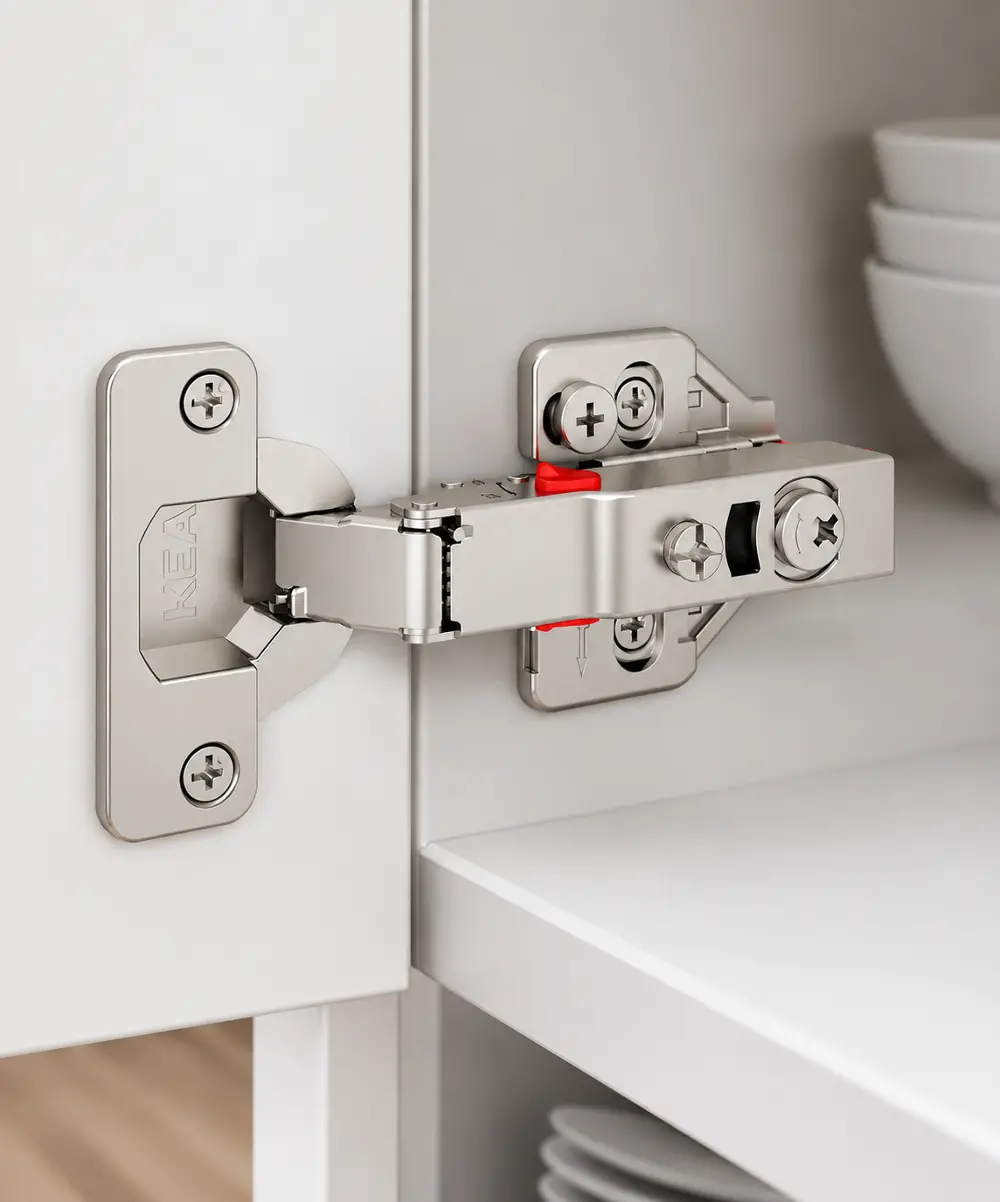
Lateral adjustment controls the horizontal gap between the doors. Turning the center cam screw pushes the main arm left or right. This movement is microscopic but multiplies over the entire length of the door panel. You must adjust both the top and bottom mechanisms evenly.
Depth adjustment dictates how tightly the door rests against the cabinet box. The rear cam screw moves the entire arm forward and backward along the mounting plate. A door set too far back will bind against the frame. A door set too far forward leaves an unsightly gap.
Vertical adjustment relies on the mounting plate itself. Loosening the base plate screws allows the entire assembly to slide up and down. Some advanced plates feature a dedicated vertical cam screw for millimeter-precise lifting. Always support the weight of the door when adjusting vertical alignments.
Knowing how to fix cabinet door hinges means making tiny, incremental changes. Turning a cam screw a full rotation usually pushes the geometry completely out of bounds. Move each screw a quarter turn and test the closing action immediately.
Metallurgy and Corrosion in Hinge Systems
Raw steel degrades rapidly in humid environments like modern kitchens and bathrooms. Protecting the base metal requires advanced layered electroplating. A direct nickel coating onto raw steel often results in microscopic surface pores. Moisture penetrates these hidden pores, initiating unseen subsurface rust.
Engineering standards dictate a dual-layer approach for long-term survival. The stamped steel is first submerged in a copper plating bath. Copper acts as an exceptional bonding agent, filling microscopic surface imperfections. This creates a completely sealed, uniform foundation for the external layer.
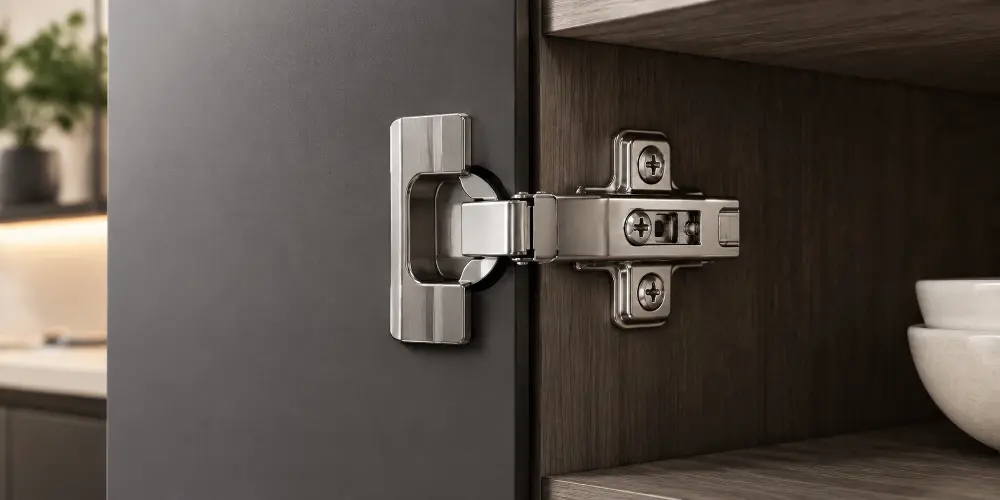
A thick nickel plating is subsequently applied over the copper base. Nickel provides high resistance to oxidation and creates a hardened wear surface. The internal pivot pins must withstand continuous friction without shedding this protective skin. Rust creates friction, and friction tears mounting screws from wood.
We evaluate this surface durability through accelerated salt spray testing. A 48-hour continuous salt spray exposure simulates years of highly corrosive, humid conditions. Hardware surviving this threshold maintains its structural integrity and ensures the pivot mechanisms do not seize over time.
The Fluid Dynamics of Hydraulic Dampers
The soft-close feature relies on complex fluid dynamics housed within a tiny metallic cylinder. A piston pushes against hydraulic oil when the door swings shut. The oil is forced through microscopic bypass valves, bleeding off the kinetic energy of the heavy door.
Cheap dampers utilize low-grade seals that degrade under continuous pressure. Once the internal seal fails, the hydraulic fluid escapes into the outer casing. The door will immediately lose its braking capability and slam against the frame. The internal cylinder is completely sealed and cannot be repaired.
Temperature fluctuations affect the viscosity of the hydraulic fluid. Cold winter mornings make the oil thicker, causing the door to close sluggishly. High summer heat thins the fluid, slightly increasing the closing speed. Precision dampers use synthetic fluids engineered to resist extreme temperature-induced viscosity changes.
Advanced two-way force modules prevent the door from slamming while also preventing aggressive spring-back. Traditional springs pull the door shut violently once it reaches a specific angle. Regulating this closing arc protects the structural integrity of both the door panel and the cabinet box.
Application Scenarios and Load Distribution
Hardware selection must align perfectly with the physical dimensions of the cabinetry. A standard residential kitchen cabinet relies on two hinges per door. Large-scale custom wardrobes may require up to five units to distribute the heavy panel weight safely.
The spacing between these anchor points dictates the mechanical stability of the installation. Grouping hardware too closely at the top leaves the bottom susceptible to warping. Spreading them evenly divides the horizontal shear forces mathematically across the entire cabinet sidewall.
| Technical Metric | Standard Residential Hardware | Professional Grade Specifications |
|---|---|---|
| Base Material Core | Standard cold-rolled steel | High-gauge cold-rolled steel |
| Plating Process | Single nickel immersion | Copper-plated under thick nickel |
| Cycle Endurance Test | 20,000 opening cycles | 80,000+ opening cycles |
| Alignment Capability | 2-way manual adjustment | 6-direction 3D cam adjustment |
| Environmental Stress | 24-hour moisture resistance | 48-hour salt spray certification |
A professional-grade system surviving 80,000 cycles ensures the internal cam tracks do not wear down prematurely. Twenty openings a day equates to over a decade of continuous usage. Metal fatigue is the silent killer of cabinetry, turning a smooth action into a grinding mechanical failure.
Technical Misconceptions and Hardware FAQ
Why does tightening the screws not stop the door from sagging?
Tightening a screw into a stripped hole provides zero clamping force. The threads have nothing to bite into. You are merely spinning the metal in empty space. The wood substrate must be repaired with epoxy and dowels before any screw can hold tension.
Does thicker steel mean a better hinge?
Thickness is irrelevant if the steel alloy is brittle or the stamping geometry is flawed. High-gauge steel with poor carbon distribution will snap under shear stress. Intelligent engineering relies on reinforcing ribs and precise pivot geometry rather than just adding raw material mass.
Can adding a soft-close damper fix a door that is too heavy?
Hydraulic dampers only control the velocity of the door. They do not increase the load-bearing capacity of the mounting plates. A heavy door will still rip the screws out of the wall, it will just do so quietly. You must add more hinges to support excess weight.
Why are my doors perfectly aligned in summer but rubbing in winter?
Wood expands and contracts with ambient humidity. Solid wood doors swell in humid summers and shrink in dry winters. The hardware itself does not change size. You must use the 3D cam adjustments seasonally to accommodate the physical expansion of your organic door materials.
Long-Term Maintenance and System Reliability
Mechanical systems require periodic observation to prevent catastrophic failure. A door that begins to bind is signaling an alignment shift. Ignoring this friction forces the pivot pins to bear loads they were not designed to handle. The steel will eventually yield.
Keep the internal mechanisms clear of dust and cooking grease. Airborne kitchen oils combine with dust to create a highly abrasive paste. This paste works its way into the pivot joints, slowly grinding away the protective nickel plating. A quick wipe preserves the mechanical tolerances.
Never apply heavy petroleum grease to a concealed hinge. Thick greases attract more abrasive debris. If the pivots squeak, a single drop of dry PTFE lubricant is sufficient. The hydraulic damper cylinder is permanently sealed and requires absolutely no external lubrication.
Proper hardware selection combined with routine observation eliminates repetitive maintenance cycles. Understanding the underlying physical mechanics empowers you to resolve alignment issues permanently. The internal geometry dictates exactly how the loads transfer into your cabinetry framework.
The next time you need to determine how to fix cabinet door hinges, you will look past the surface symptoms. You will evaluate the horizontal torque, verify the eccentric cam positions, and inspect the structural integrity of the wood. Proper calibration ensures decades of flawless mechanical operation.
CONTACT US


GuangDong JinLi XiangXing Precision Metal Manufacturing Co., Ltd.
We are always providing our customers with reliable products and considerate services.
If you would like to keep touch with us directly, please go to contact us
-

Home
-

Tel
-

Email
-

Contact